Risk vs Adoption framework
A product/feature is successful if the proposed value was delivered to the customer and the organization made $$ because of that (assuming you are working for a for-profit organization). One of the ways to measure the value delivered is to measure the success metric that was set for that product/feature.
Usually, adoption of a feature is directly related to the success metric. More usage of a feature tends to be a good thing (most of the time). The way to increase the adoption is to make it easy to use a feature (reduce friction, maybe clicks) and/or let more personas use the feature.
Here is the tradeoff: making a feature easy to use or letting more personas use it might risk someone misusing or wrongly using the feature, which might lead to a negative impact (risk) for the customer.
This is what led me to believe there ought to be a risk vs. adoption framework.
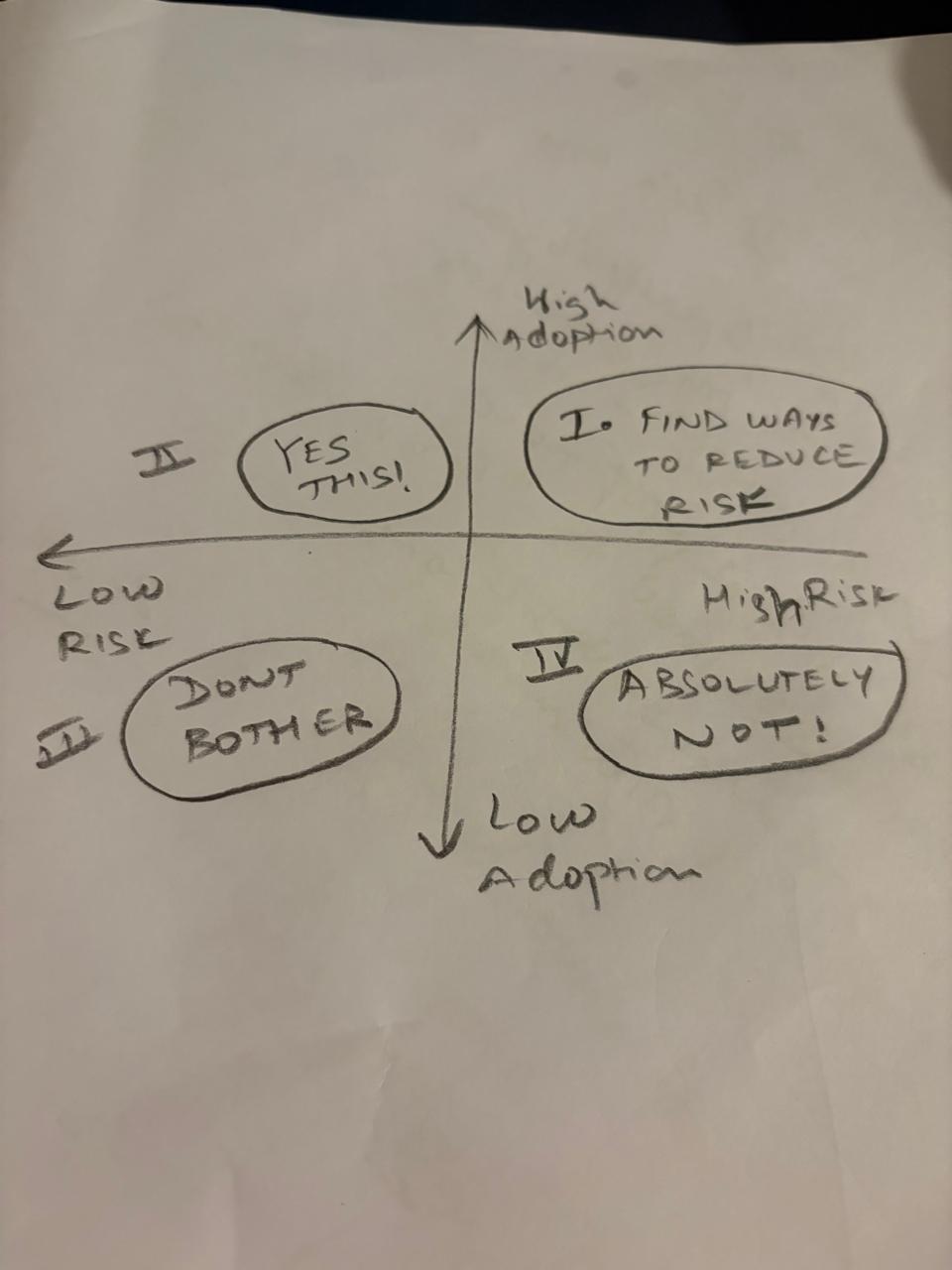
This is where your creative thinking has to kick in. This gives you high adoption, but the risk is higher too. This is a feature where you can differentiate from the competition if you find the right way to reduce the risk. You may have permissions on which persona can use this feature, but go with a good enough default so it does not hamstring your feature. Alternatively, you can open this to all personas, but you can define a default blast radius. (Example: WhatsApp limits forwarding a message to more than 5 groups at once. Or default transaction after adding a payee is limited for 24 hours.)
No brainer. Go for it. You are lucky if you land in this quadrant. You hardly land here. Example: send voice message on WhatsApp, iMessage, or Telegram.
For items with low adoption, usually don't bother unless that one big deal is dependent on that feature.
This is an absolute no, because there is high risk if someone uses it and no adoption. Hard to find these features in the real world.
All posts are written by human.